Find Your Podcasting Style: Script, Outline, or Freestyle

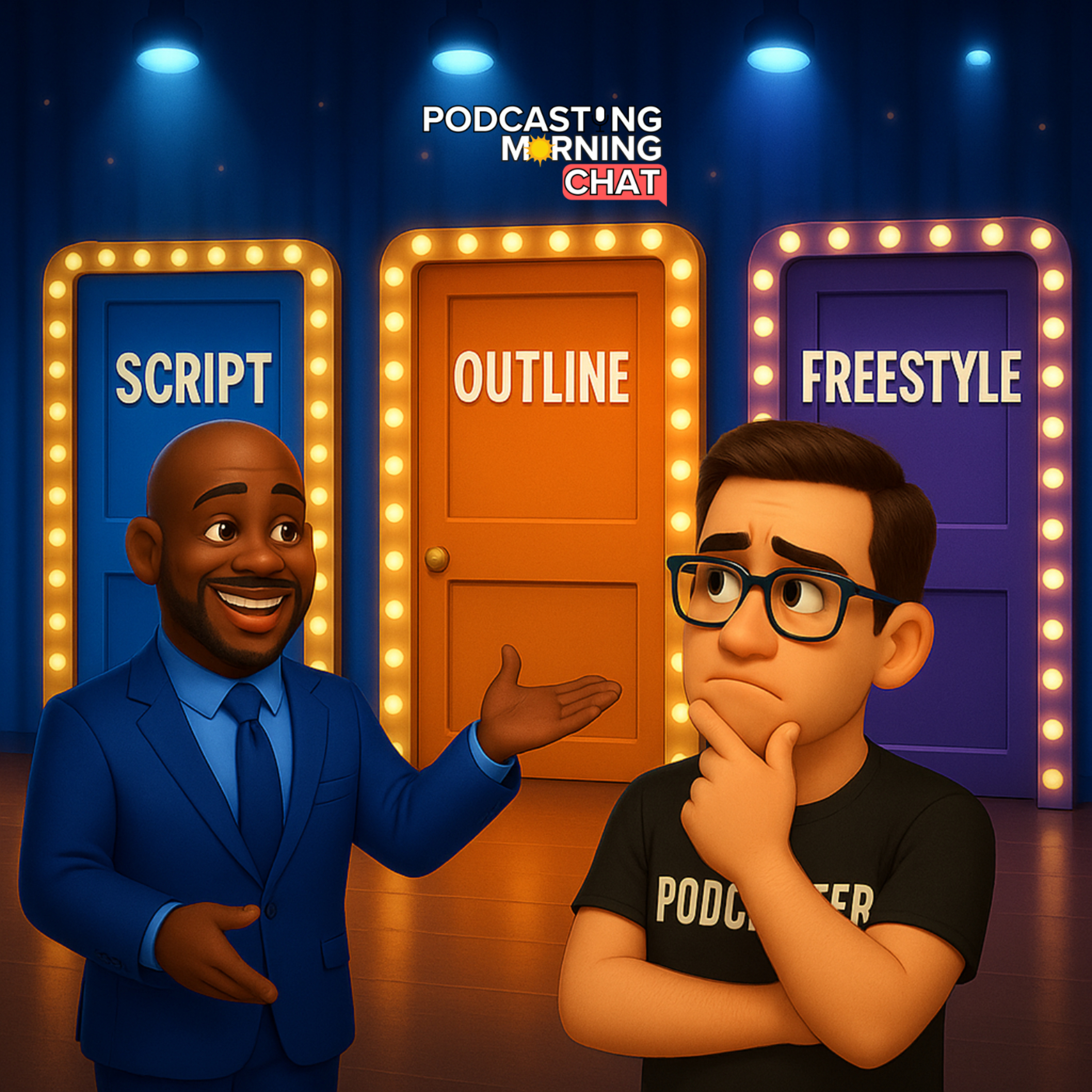


How do you prepare before you hit record? Do you plan every detail, keep a loose outline, or just hit the red button and go? Today, we’re sharing how we approach preparation and how those choices shape creativity, confidence, and the listener experience. We give tips on making a script sound natural, and why there’s no single right way to plan a show. You’ll also gain insights into time management and maintaining fresh ideas. Ultimately, it’s about showing up ready to create.
Episode Highlights:
[03:00] Podcast Evaluation Announcement
[07:15] Icebreaker: One Word Prep Styles
[13:32] Discussion on Scripting vs. Winging It
[23:56] Approach to Scripting
[29:43] Evolution from Scripts to Bullet Points
[38:33] Season Preparation Strategy
[47:54] Our Podcasting Morning Chat Categories
Links & Resources:
Join The Empowered Podcasting Facebook Group:
www.facebook.com/groups/empoweredpodcasting
The Runner's Sole with Sharon Miller:
https://podcasts.apple.com/nz/podcast/the-runners-sole/id1844808510
Breaking The 5th Wall:
https://www.youtube.com/watch?v=RRDJO_UV4I8
Remember to rate, follow, share, and review our podcast. Your support helps us grow and bring valuable content to our community.
Join us LIVE every weekday morning at 7 am ET (US) on Clubhouse: https://www.clubhouse.com/house/empowered-podcasting-e6nlrk0w
Or Join us on Chatter: https://preview.chattersocial.io/group/98a69881-f328-4eae-bf3c-9b0bb741481d
Live on YouTube: https://youtube.com/@marcronick
Brought to you by iRonickMedia.com
Please note that some links may be affiliate links, which support the hosts of the PMC. Thank you!
--- Send in your mailbag question at: https://www.podpage.com/pmc/contact/ or marc@ironickmedia.com
Want to be a guest on The Podcasting Morning Chat? Send me a message on PodMatch, here:
https://www.podmatch.com/hostdetailpreview/1729879899384520035bad21b
0:04 Good morning podcasting Morning chat. Today is Tuesday, October 17th, 2025, and today we're showcasing podcast prep styles across the team. Get a behind the scenes look at how different hosts prep plan or just record. We'll talk about their scripting styles as well. So if you're listening live on Clubhouse, on Chatter, on YouTube, hit the share button, bottom left hand side of the screen on Clubhouse and share it. However, Clubhouse lets you. And if you're listening via podcast, please share this with a fellow podcaster. And now give me about 30 seconds and we'll get things rolling. Thanks for being here.
1:13 Good morning again podcasting morning chat. Thanks so much for being here. I am your host Mark Ronik and currently here with me we have Dr. Faye, Ashley Feller, Alex Baelish and Sid Meadows. And as I said today we are going to discuss prep styles. More importantly, we're going to talk about how people script outline or how they just wing it because I know there are podcasters in this community that does in fact wing it. And I want to be clear, I don't believe there is one style that's better than another, at least generally speaking. I think everybody has a style and they choose a style that works for them.
1:56 By the way, thank you for bearing with me, being patient with us. I know that yesterday we technically said we were going to do a show and we didn't because I was still battling some of my insomnia issues. So I woke up at 1:45 AM on Monday morning and could not go back to sleep no matter what I tried. So this is an ongoing thing that I am working on. I am committed to dealing with. I don't know what that looks like yet. Maybe I'll do sleep studies. I think being just real with you guys for a minute, I think I'm dealing with some stress and anxiety. I don't know if that's a carryover from the stress of putting on the conference, but whatever it is, I'm going to get to the bottom of it because I can't keep doing it like that.
2:47 Today. I did wake up briefly at around 3, was able to get back to sleep around 4 and sleep for another hour or so. So to be continued on that other housekeeping, Oh, I wanted to let you know that we are working. We told you last week we're going to start doing podcast evaluations. Even though Dr. you hate that word evaluation, but we are going to do those and we are starting with a show that Dr. found. Dr. you want to tell us a little bit about that show? Just a sneak preview for Thursday because our we, you know, our hosts, our Co hosts here are listening to the show, taking notes.
3:28 And then we're going to talk about things that we think work well, things that we think could be improved. We'll talk about everything right from like their cover art to the actual title of their podcast series. We'll break it all down for this person. You want to share a little bit? It's good that I'm sharing now because I would love for the listeners to tune in so as we give our feedback, they can analyze it and they'll they'll know what we're talking about when we say and this part and that part and we're going to be playing clips from it. So this particular podcaster is, I believe she's from Australia. She is a professional podiatrist and the name of her show is called The Runner's Soul, SOLE Soul.
4:19 So it's interesting. She's got, there's a lot of unique things in it. There were some surprising things to me, like I thought there was some things in it that was really going to bother me, but it didn't at all. And. Are you giving your whole evaluation right now? I'm not not being specific, I don't want to be specific, but it's interesting and I hope the rest of our team will. Basically, we're asking you to do homework and listen to it's only 15 minutes, folks, it's only 15 minutes. So if you could, please listen to it and join us in the feedback. Yes. Evaluation.
5:00 Yes. That would be great. So that's the runner's soul. And you found this is the Hostess, Sharon Miller. And you found this where? On Facebook. And she was actually asking for an evaluation. Right, that's right. And that's the important thing. She we're not just choosing 1, you know, Willy nilly and saying we're going to, we're going to evaluate your no, she's asking for feedback. And by the way, if any listener out there wants feedback on their podcast, and it doesn't have to be brand new, IT could be you could be a seasoned podcaster and be doing it for years and maybe you've hit a slump or something and you just want, you know, some expert opinions.
5:43 That's what we're doing. I'm excited about it. Yeah, me too. I think it's a great way to do this show a little differently and still help a lot of podcasters in the process. I think this is yeah, you'll get some strong opinions and you'll yeah, it's not maybe your show that we're talking about, but you might learn a few things to help you along your journey with your podcasting. And again, that's the runner's soul SOLE. You can find that on all of your favorite podcast platforms, including YouTube. Although it is, it does seem to be an audio first podcast. Check that out and then you can follow along even better on Thursday. But we promise you, even if you haven't listened, we're going to share clips. We're going to share all the things about it so that you are in the know and that you can follow along too. So stay tuned for that.
6:32 By the way, a good morning to Matt Bliss and also to Feel Better, who have joined us here on stage. And of course, a hello to those of you joining us live here on Clubhouse and also on Chatter. Jonathan, do we have anybody in the Chatter room right now? You can be honest. We have three people. Biffy, UL and Rosie are all over here. Awesome. So welcome guys. Welcome. I saw Rosie popped in here on Clubhouse and chose to go to Chatter and that's cool. Pick your choice. I'm not going to say Poison because I like both platforms. All right, let's start things off with an icebreaker all around. Again, this topic of how we prep for our shows. I'm going to go down the line. I did ask the the Co host here to think about this question in one word. Tell us what your your prep style. One word for your prep style.
7:18 Let's start with you, Dr. as far as your podcast prep, one word for it. And you can use this very show as your as your Guinea pig for this if you'd like. Oh, prep, this is hard. You didn't tell me you're going to make thirsty sort of a gun. I I can move on and I can come back to. You. Yeah, move on. Ashley, how about you? I know you said when I sent this out, Ashley, you said I'm feverishly prepping my answer. So do you have an answer for this one? One word for your prep style, Ashley. Rushed. Otherwise rushed. Rushed. I feel that I could relate to that because admittedly, and I have shared this before, a lot of times we are preparing the day of meaning the hour or so before we go live at 7:00 AM.
8:08 So sometimes DRI think you can relate. Rushed might be one for you too. We're working on that. I just shared that yesterday I was prepping everybody for what some of the things we talked about today. So I'm getting a little better at that and also feel better who's here with us has offered to help a bit behind the scenes with producing, production, etcetera. So that'll be handy as well. And looking forward to maybe changing that word from rushed to something better, maybe controlled. Let's go to Alex. Alex, one word for your prep style. Structurally loose. OK, 2 words, but I'll take it.
8:49 Structurally loose. OK, I like that. Let's go to Sid. How about you Sid? One word for your prep style. I could want everybody, my word, one word would be organized. Oh, I like that. And not surprised really, knowing Sid, especially after Friday talking all about how all of his plans for his revamp of his podcast sounded very organized. All right, Jonathan, coming to you on double duty here. One word for your prep style. I get 2 words 'cause I'm doing double duty now. Sure work I would say is my word. Say pre work, pre work. OK got it. Pre work. Yeah. OK, cool. And then Matt coming to you. Matt Bliss, how about you? One word. Good morning everyone.
9:30 Serendipity, I think is the kindest way to. Now I have to stop there and ask you, can you share a little more? Why serendipity? Well, look, Ashley said rushed. I would describe myself as that too, as I'm currently writing the episode that I'll record after this session today and release tomorrow. But often for rethinking podcasting, it's comes from ideas that I hear out in the world that I process internally and have an idea about. And I don't really do a 20 week content plan for that. So the serendipity is, you know, we talk about something on PMC or I read something and it matches to an idea of I've been interested in, in philosophy or deep thinking or whatever. And they just, the 2 just come together. I like that, and I like that we can inspire some of your content in some way, shape or form.
10:22 That's awesome. Very cool. All right, Feel better coming to you. One word for your podcast prep style. Random. It's completely random. I need to hear more. With the interview show, because I like to learn about the person, it's like last minute I will start reading and writing their info to the podcast or I'll randomly figure something else out. There is no straight line in what I do for my production. It's just let's go, let's see what happens. It's random every single time. Phil, would you say that is in line with other things for you or is that specific to the podcast? It's specific to that podcast because I I love conversations so I try my best not to learn about the person. So my the pre production is very random and then afterwards production is very straightforward. OK, gotcha.
11:21 I'm sure that's relatable to several podcasters. With hope. Thank you, Phil. We'll come back to you in a moment and everybody, for that matter, in a moment. Chris has joined us from the audience. Good morning. Chris. Did you want to play along and share one word that describes your style? I don't really prep, I reboot the computer, but that's about it. So when you say none I mean when you hit record you at least have or I don't know this. So do you have a a topic in mind or do you literally hit record? I have AI have a topic in mind, but sometimes I just find somebody interesting. We just let it go. I want the conversations to seem natural and.
12:01 Thank you, Chris. And I think that is a tough call. I think a lot of people have debated that at some point or another because similarly to I think what Phil is saying too is he likes those conversations to just go in a direction and see what direction it goes in, right? He's not and he's purposefully not prepping to learn a lot about the guests so that it can feel like a very new conversation. And look, that's a whole other topic we can get into at some point. And we have before just that. Some people will argue that's the best way to go for a podcast. Others will say no. I, I think preparing, having your questions answered, knowing who this guest is on the other side only enhances it.
12:42 So it's just whatever side of the coin you fall on. I don't think there is a right or a wrong there. Thank you. OK, so cool. Now we've got a good idea of people's different prep styles. One thing I want to ask everybody if you would be so kind, put in the chat a number one, if you script your podcast, that concludes everyone on stage as well #1 if you script your show word for word, like you work from a script A2 if you outline a three, if you just wing it. Curious to see what people say here. So we've got several twos and then one one.
13:24 All right, so it looks like we've got twos and threes mainly. Good to know. OK, so with that, let's jump in. Let's talk to you, those who script. And I guess you know that that can vary, but I know Matt is one of those people. I know Sid does some scripting. I'll go to Sid first. Talk to me, Sid, Tell me a little bit about why you choose to script and what parts of your show you're scripting. So part of my show that I script is an episode that's a 10 minute episode that I have called tend to Win. And it is repurposed from an article that I've written for the magazine that I write for. And so when I need or when I want to do a tend to win episode, then I just grab one of the articles that I wrote and I use that.
14:09 I print it. I read it out loud, see how it sounds. I highlight words that don't sound like I would say and I kind of change things up and then I edit it the document, put it in the folder and use that as my script. I definitely do a lot of ad libbing with it. I'm not, I'm reading it, but I'm not just like reading it very boringly going through word for word. So I'm ad libbing along the way, but it is from the article that I've written so I'm repurposing content. Why script it over just hitting record or either winging it or going with the outline? Just because it's easier, it's already done. I mean, I'm spending very little prep time with it.
14:51 The article is there and it's already broken down into the aspects of the way that I wanted to do it. So it's already done. So I'm just repurposing. OK, cool. And so how do you keep it or do you know if you're keeping it to sounding very natural, like how do you do that? So or, or do you not since it is a blog and specifically and maybe you're letting your audience know you're reading from it, like what? How do you keep from sounding natural? Or I shouldn't say keep away from, but how do you keep it sounding natural? I don't know that I can actually explain it, Mark, other than I make sure that I'm using different voice inflections. I'm breaking in the sentences and, you know, adding a little extra commentary of words that aren't written there. I'm kind of laughing at a couple of things like, oh, wow, this would be really fun if you tried this, but that may not be in the script.
15:40 So I just try to be very natural with it. I mean, I've never had anybody say, why are you reading a script? I honestly don't know that. If you didn't know that I had a script in front of me, I don't think you would know that I was actually using the script. That's my opinion. I could be way off base with it. Yeah. And I think what from what I usually hear and sometimes I know if you've scripted something because you've talked about it in the past maybe for short form video or what have you. Yeah, you do generally speaking sound very natural when you're doing, and I'm sure that adding the ad libs helps that whole thing feel like more natural all to all together. So yeah, I think throwing in some ad libbing can really help that. One of the things I do in the scriptures, I go in when I know I want to make a pause and I spread the words out or I put dots, you know, like dot dot dot dot dot. And that's like a visual indication for me to slow down or take a pause at that moment or to ad Lib into it. So I do do things like that to make it better. But I'm not a fan of just, if you can tell somebody's reading a script and it's just very boring and monotone and you know, then I'm not, I'm not a fan of listening to that. I'm certainly not a fan of creating that. One of the ones I had recently, I was not happy with the recording, but I was out of time and I felt like they're recording the most recent tend to win felt like I was reading in some places.
17:03 It wasn't my quote UN quote best work from that perspective. But some of the other ones you know you can't. In my opinion, you can't tell. Fair enough. Thank you, Sid. Appreciate that. And I'm going to check in with Matt. I know Matt is also somebody who scripts some episodes. I don't think he scripts every episode. But let's talk a little bit. You've been podcasting for a while now and a natural at it in my opinion. I enjoy listening to your podcasts and I'm curious why you feel the need to script. And that's not a judgement, it's just a question. It's all good. I accept no judgements. It's all just a difference of opinion that we'll discover as we go on to. Yeah. Now, mentioning my podcasting history, I've had, I think I've had six or seven at this stage.
17:46 And the majority of the time when it's conversational, I won't script it. I'll have some guiding questions for interviews that I still do today for the interview episodes on Rethinking Podcasting. And that's that makes sense. Like the conversation probably shouldn't be scripted and is might be even be a fictional show, right? Yeah. But the monologue episodes that I do, the ones that are just me talking to an idea, the way that I connect the ideas together and the efficiency that I need from those ideas. And also the congruence. Like I can't waffle on about some weird thing and go on a like a raw random tangent when I'm trying to make a specific point. The episodes that I do as a monologue are entirely scripted because I'm making an argument.
18:35 I'm making a case for a certain contention based on a series of premises that lead to the conclusion of the argument, and for this reason I write down all the ideas into separate parts. Each part is a premise of the argument leading to a conclusion, which I'm still looking to improve and get better at, but I just don't want to wander off with that kind of thing. And the the ideas that I'm dealing with when I try to make these postulations, some of them are very highfalutin and I don't expect everybody to to be on board with the most of the time or even fully understand them as they can get quite complex. But I think for myself being, oh, the other thing I should note too, part of the reason I do it is because the conversational tone that I take with a scripted episode largely comes about from practice.
19:28 I used to deliver training, the same training over and over and over and over again about technical applications, about some human resource stuff from back when I worked in government. And eventually you get to a point where you just remember it, but you're saying the same thing over and over again. And you need to sound conversational to keep the person engaged and have it not be a death by PowerPoint as you deliver that stuff. So there could be a bit of privilege there with me reading from a script and having it not sound so much like it comes from a script, and also me being passively quite a monotone character. For the most part. I'm working hard usually to try and get the animations in there.
20:11 But the most important reason why I do it is that the idea, the episode, the topic and the argument has to make sense. And if I don't script it, there's a chance it won't. And I'm not doing a lot of post production to try and, you know, fit that in. I've done that and before and it's not fun. Thank you, Matt. I appreciate you digging into that and really breaking down how you script it. I think that's a lot of valuable info in there. And do you do something similar that Sid does where in your script you're, you know, adding the dot, dot, dot or something to indicate here's where I need to pause because I know I do that too.
20:53 I do that in my, the only places that I script and really it's all at this point mostly by memory anyway, but is in the intro. I have my intro every morning that I do have scripted, especially that part where I say, and today, and so I will, I'll put dot, dot, dots. If there's a word or words that I want to emphasize, I might put them in all caps or I might make them bold. Do you do stuff like that? I don't. I would if I didn't do this other thing that I do, which is a preservation of avoiding the need to do something like that. I find that if I script an episode and I wait until the next day to record it, that the rhythm, the intonations that I choose based on the punctuation can sometimes get lost.
21:43 Like my word order can be a little bit unusual sometimes. So generally to avoid the need for ellipses or pause notation or taking a different rhythm with a certain set of words together that would otherwise be rhythmically different, I try to script and then immediately record and then the not the tone, but like the, it's called the music sheet. You know, the notation sheet actually will help me out there, but you know that it preserves the rhythm, the notes, the progression, the timing. All of those things are preserved if I record immediately after writing it. Whereas if I do it another time, like the sheep kind of disappears. I miss the timing, I miss the speed, I miss the pacing sometimes.
22:27 And I need to re record things. So my soul for that is record immediately. Yeah. Yeah. OK, cool. Thank you, Matt. Appreciate you appreciate that insight or those insights. And real quick before I go to Yvonne, 'cause I know Yvonne has shared in the chat that she does a little, little bit of scripting as well. I do have to shout out, 'cause I didn't get to it at the very top of the show, have to shout out Dominic Lawson, our one of our fearless leaders of this community. And yes, he hasn't been able to join us as frequently anymore these days in the morning, but still very much part of this community. And I want to congratulate him on increasing his awards to becoming a 42 time award winner.
23:11 He won several awards this past weekend at the Afrozen Audios convention in Baltimore that we've been talking about for a few weeks now. But I believe these were the Black Podcast Association awards, like this was brought to you by the Black Podcasting Association. And either way, he has won multiple awards from that event, including Best Podcast Network. And so, yeah, Dominic just continuing to kill it in the world of podcasting. So if you haven't seen Dominic talking anything about it on social media, definitely go check out his social media pages and give him some love. Give him some congratulations.
23:54 He's certainly earned it. OK, So let me go to you, Yvonne, as one of the final scripters on stage. Why? Why do you script it? You know, I know you said in chat here, your intros, your outros, what, what really is it about scripting those that you prefer versus maybe an outline or just winging it? I will forget to say something that I like, some sort of call to action in the outro. I'm, I want to make sure I get that in and I do the intros specifically because I really want to be on point and not wandering all over the place with my thoughts. That's the same for solo shows and very much a lot of what Matthew said I resonate with.
24:43 There's a point I want to make in a solo show and I don't want to meander as my mind tends to. As a fellow ADHD Mark, I have a bit of a pinball brain and I can interrupt myself and go off on another tangent. And so be Having a script in front of me or at least an outline helps me to stay on track. And I do have theater experience and a lot of theater experience. So I will say I'm good at making scripts not sound scripted. I also do a lot of what Sid does. I feel free to add a little something extra, you know, a commentary here and there on something that I put in the script.
25:29 Oh, you know, it hits me in the moment and I say it. I feel free to go, you know, off script a little bit and just let it breathe. Yvonne, you did an episode recently, you put out an episode about your experience at the Empowered Podcasting Conference. I watched it on YouTube, particularly because I know you're working on learning YouTube. So I wanted to give you some views over there. And what, how did you do that episode? Was that scripted? Was that an outline? That was scripted. And again, with the freedom to go off script, you know, any, any time I have a script in front of me, I do not feel like that script is that I have to be exactly word for word.
26:13 It's there for me to reference so that, you know, I usually have a Google Doc open in front of me. And so I can go down and look at what the next point is. I can grab that point and I look back up and what comes out of my mouth may not be exactly what's in that script, especially if I'm doing it on camera. If I'm just doing an audio only podcast, that's not as much of an issue. I really make sure that the things that I want to deliver with impact, I make sure that I know what I'm saying in those parts so that I can really be looking at the camera in that moment and delivering that with full intent and not with a little bit of wiggle and squiggle.
27:01 You know, like what am I saying? What am I saying? Those, those things I'll, I'll go over a little bit and maybe re record. If I feel like I wasn't quite solid on that, I'll go back and re record that. Cool. Thank you for sharing that. And D, so you know, I'm hearing that you practice in some regard. Do you ever practice like word for word going through the script and if so, how many times? Not much I do, and I might maybe a couple of times again to keep it. I don't want to memorize. I want to have a solid idea, a solid road map, let's just say in front of me. So that keeps me from just getting the wanders.
27:45 Yeah, your brain even just practicing it a few times, not to the point of memorization, but your brain starts to remember anyway, right? It, it's kind of like building that neuro pathway in your brain so that when you go back to the actual script, when you're doing it after hitting the record button, it, it does come more natural cause your brains more used to those words on that paper and you and it remembers the next several words as it goes because usually you're cued and so your brain gets AQ in some way, shape or form. So I love that. And I do encourage that a lot to the people I work with. If you're going to script, fine, but read it out loud and I mean out loud, not it to yourself because I don't think that's as effective.
28:30 I think if you read it out loud several times, you do build that, that pathway. It does make it a little easier when you do hit record. Yvonne, did you want to say something? Doing it out loud is key. You, you can't, like I don't just write it down and then and then go blah, you know, immediately. Because when you write something, sometimes it doesn't sound the way you speak. So sometimes it may need a little bit of modification. And that's the other reason why I, I don't feel beholden to my script is because I know it's the written word, not the spoken word. And I trust myself enough to modify as I go.
29:11 I know when I write, it's a slightly different voice than when I speak. And if I am reading straight from something I've written, it's so clear that it's not coming from my head, in my opinion. So I'm with you there. I have more to say about all this, and I want to check in with Ralph, who's joined us on stage. So good morning to you, Ralph. Did you want to add on to all this? And I know you probably put it in the chat and I've probably forgotten. Are you a scripter or do you outline or do you just kind of freestyle it? So what I was saying is I hired a talent coach about nine months ago and I had built this nice studio here, my office. I have a teleprompter from the prompter people, you know, really nice studio thing. And I was scripting out all my episodes. And he says, Ralph, he says, it's like you're talking to nobody.
29:59 And I said, yeah, I feel like that someday. So we went through his whole evolution of moving away from the script. And then we went to bullet points. And he said, I still feel like there's a disconnect. So I did something about a month ago. And if anybody has the opportunity to do this, it was massive for me. I actually hired Ava and my VA joins me in my recording every day and I see her on the screen. So I'm, it's like I'm talking to somebody. And it's really helped me connect with somebody because I had this disconnect. Like I do a Daily Show and I do 2 weekly shows, but my Daily Show especially it's about 10 minutes long. But I really want to connect with a person. It's a Christian finance show and I want to connect with a person that's experiencing a pain point. And I just felt like there was a disconnect, 'cause my coach kept saying, Ralph, when you and I talk in a Zoom meeting, man, you're dynamic. I can understand you.
30:45 It's great. But then he says you get on your your regular daily pocket and it's like there's a little bit of a not that's not Ralph fate. And I'll tell you when I moved away from the script, I moved to more bullet points. Now I will still put things that I make sure I want to say because I I still use the prompter for that, but it's really helped me be more dynamic in my presentation to move away from that script so much. And I find myself AB living. And the truth is when we have conversations with people, that's the way we naturally talk. We don't talk in bullet points. We don't talk in, you know, fully designed script. So that's been really helpful for me. I love that. Thank you, Ralph, and thank you for sharing a little bit about the talent agent or the talent coach.
31:25 I think that's a a really interesting one and very cool to hear how you're utilizing Ava. And I want to say to anybody listening, you don't necessarily have to get Ava, get a friend, get a family member, get somebody to sit across from you, whether it's on the screen or in person. And I think it does help change your dynamic and how you deliver. So great advice. He hired the Veterans Administration. A virtual assistant, a virtual assistant, VA. Thank you, Chris. Jonathan, did you want to jump in? Well, I just wanted to welcome Amanda Yoa over here. She's joining me as a mod over on Chatter. I just wanted to share.
32:08 Just put a picture of a loved one right behind your camera lens. It works like magic. Just like that as you said that Jonathan Tim at simultaneously in the chat said I have a picture of my avatar, meaning his ideal listener luckily and I talked to the picture so yeah there you go. That's some others are doing that as well. I have encouraged my a lot of my clients, a lot of my new podcasters who are just kind of getting their feet wet, a little nervous, feel a little uncomfortable solo podcasting. I've suggested that and I have some clients that are still doing that to this day, even though they've become very comfortable behind the microphone. Matt, can you tell us a little bit about what you put in the chat regarding void talking, what that is and how that's helpful or not?
32:56 I yeah, I want to hear more. So the periods during the pandemic lockdowns, I'm actually writing about this in the scripts doing for the episode going out tomorrow. So if you want to hear more could go there. But void talking is something that people talk about a lot. Talking into the void, it was something that I experienced a lot at the beginning of the pandemic, lockdowns in Melbourne in the job I was in, because there wasn't really a common understanding of how human connection happens digitally. And with the organization I worked for and the rollout of a new set of teams at the time, it was only rolled out like a couple of months before it all kicked off. So what it meant was that when I ran training digitally, which I used to do in person, I would begin the session, I'd tell everybody to mute their microphones, turn off their cameras, and I'd talk to a bunch of letters.
33:51 And that wasn't necessarily the most ideal. There was an interesting phenomenon that arose as a result of that as well, that particularly in Teams, your eye was not drawn to the people you were talking to, it's more drawn to yourself. I think Zoom characterized this as some sort of word. But in any case, you're looking for a place to talk to and like even Ashley's thrown in the chat there, talk through the camera. All of these are skills that we, I don't think we really had five years ago. We take them for granted today with all of the digital work and media stuff we do. And when I was doing it back then, it was literally talking to the void. It was like trying to imagine and invent being in front of a room of people to try and simulate the classroom experience, but you're talking to nothing.
34:41 You're getting no feedback. And as someone with who has a teaching background and a learning development background, that feedback is super important. Like you're looking for when people nod their head or shake their hands or cross their arms or, you know, look out the window and tap a pen. And if you don't have that, it is literally the void. Like they could be getting value, they may not be getting value. You have no idea. Talking to that void in order to create a dynamic experience is a skill that can be can really only be developed through practice. And essentially what's being described here is talking into the void with the practical tips people have mentioned already, like putting an avatar on the screen, sticking a poster under the camera, talking through the camera, looking down the lens, imagining, thinking about the person that you're talking to or the people, whatever means that you undertake in order to be able to not think about it. Like talking into a black hole, but instead of that trying to connect with someone or something or some people. That's the way that you get around that kind of thing. But I think it's a phenomenon that's that's probably not thought about much today with how digital we all are. But back then, I mean, people might have a different experience, but 2020 was way different. Thank you Matt Void talking.
36:03 Coincidentally, this did not happen because of today's episode or this didn't inspire today's episode. Just so happens that at some point yesterday, before I even started prepping, maybe you subconsciously This is why we went here today, But I stumbled on a YouTube video on how to speak to the break the 5th wall as this person calls it. And her name is Brenda Turner. She's pretty popular on YouTube with over 400,000 subscribers. I've shared the link here. We'll share it in the show notes as well to hear a little bit more. I think that these are similar things to what Matt's saying and what Brenda is saying here.
36:43 So check that out. And of course, be on the lookout for Rethinking Podcastings newer one of the it's newest episodes that Matt's working on right now talking about this kind of stuff. So there you go. Let's see here. All right. So I think we have certainly dug into a lot of the script writing stuff. I do want to say the other thing that I like to do when I am doing anything from a script is I really like to format the script in a way that just flows easily and naturally I will, even if a sentence let's, I'm sorry, if a paragraph, let's say is 5-6 sentences long, I might break that paragraph into one to two sentences at a time.
37:30 I just find it easier this way, you know, I don't lose my spot as easily. So really breaking it sentence by sentence or a couple of sentences at a time helps me with that flow, helps me keep my pace without losing my place. And I do want to say something also to Yvonne's point about outlining, I do find the challenge, even though that's the style I tend to choose, I do find the challenge is keeping keeping up with it get making sure I hit every single point. I often times miss things like for example, the Dominic Lawson announcement. I had that at to say that at the top of the show and I just breezed by it, not intentionally. That's why I circled back to it.
38:16 But yeah, so that can be the a challenge of outlining. Let's go to Jonathan for a second because Jonathan, I saw you were chatting a little bit and I want to get the chatter side of the family represented here as well. Tell us a little bit more about your style and and how you prepare. I prepare for my season, which is about 25 episodes. I prepare for my season before I start recording any for my season because I'm really particular about not taking on somebody else's style. I want to make sure that I've my podcast feels like me. So I will do my all my research for my episodes in advance to the season starting. I write take notes on all the topics I want to talk about. Sometimes a new topic will pop in and I just take notes on that, but I use that as my outline for then my episode. Now my episodes are 10 minutes long, so they're pretty quick. I can cover, you know, just that one topic, which is the purpose of me doing it that way.
39:15 So keep it nice and crisp and something that's actionable for people to do at the end of each episode. So yeah, I just I tend to do all my research way in advance. So that's why I said pre work was how I described it. Yeah, yeah. Thank you, Jonathan. Appreciate that. Love that strategy. And by the way, shout out to Amanda Yo. I forgot to acknowledge that when you shared it. Glad that Amanda Yo is with us and on that chatter stage helping to man the Fort there. I got to use a better term than man the Fort that is outdated. But thank you, Amanda, for joining Jonathan and helping us out. Really appreciate you and love that you're still a part of this community. And by the way, Amanda, you got to join us on Friday to share wins because I know you had a big win yesterday. All right, we're just going to wait. We're going to wait.
40:02 But Amanda had a big win and made it to the local TV airwaves. I'll leave it there for now and we can hear more about it either tomorrow or Friday, depending on. What time allows? All right, so let's see here. Anybody want to share a little bit more? Let's go to Phil since Phil is kind of our freestyler here. And I know we have several, but I'm just picking on Phil for a minute. Phil, tell us a little bit more. How do you stay focused without using any notes or outlines or scripts? I find the guests interesting. So the main podcast I'm talking about is Investing Yourself, the Digital Entrepreneur podcast Selfish Plug, but I interview people who are digital entrepreneurs, anyone who's made their business online.
40:51 And I started this because I had no idea how to be an entrepreneur. So the best way of just having conversations with entrepreneurs. So there is a bit scripting I do, but it's just my intro so I can introduce the guests in a unique way so that they feel valued. But after that it's I go straight into just asking questions about their stories. So I start off with why they became an entrepreneur and then I just find questions in there that I'm interested to learn about and get more information. Because it comes down to your curiosity in a person who helps the interview sound engaging when you don't script it. If you don't have a 10,000 questions like you know you're inside the actor studio or Larry King, you know they have so many questions prepared.
41:40 I want to genuinely know this individual. So having questions feels like I'm not trying to get to know the person, I'm just trying to get answers for sound bites. So that's my thinking. I go in with curiosity about I have no idea who this person is and I want to know everything I can. So I'm going to just ask questions about the stories that they say. I love that. Thank you, Phil. I and I was waiting to say it and then you said it at the end. It sounds to me that curiosity is really what guides you through the freestyle conversations. So I think that's a big one. Like for for people who are considering freestyling or they are freestyling, you got to ask yourself, am I curious enough to keep this going without guiding myself? Fairs fair to say.
42:27 I've always been curious and my parents hated it because I always asked why. And so for that reason, curiosity, you know, doesn't kill the cat, it brings it back. That's what I always say. Love that. Thank you, Phil. And I see Jeff Dwoskin has joined us on stage. Good morning. Jeff, did you want to add to this part of the conversation? I wanted to add to Phil's brilliant, I think the same kind of approach. It's just I just had a different way to look at it that I just wanted to share. Same exact thing. It's just I always look at it as my goal is to sit down with those people as if I've known them for a very long time. And the only way to do that with a stranger is what Phil was describing and what I do, which is really kind of deep dive and then just internalize it and then have that conversation for that hour.
43:24 And then hopefully that's the vibe of what comes out, is just a natural conversation between two people that if someone were listening would be like, oh, they just met. I think that that is a key to, even if you did just meet, finding that way to really feel comfortable and make it seem like these are two almost 2 old friends. Yeah. I think that really helps the flow of the conversation and it keeps the the audience engaged. Thank you, Jeff. Appreciate it and appreciated your episode. I forget the gentleman's name now so you can chime in here and and tell me, but appreciating the episode about Cesar Romero and his time on Batman and elsewhere was really enjoying that.
44:10 Who was the guest? That was Samuel Bernstein, he wrote. Think it's Autobiography of Cesar Romero I. Was going to say, for those who don't know who we're talking about because we are dating ourselves a bit, that is the original Joker from the TV series Batman. Batman 66, baby. Yep, a very cool interview. Go check that out. And again, Jeff, name of your podcast for everybody. Classic conversations with Jeff Dwoskin. Go check out classic conversations, OK? And Matt puts in the chat. RIP Adam West, which I fully agree with. And I mean, how many years ago was that now? 3 or 4 Matt?
44:52 But yeah, I guess anytime it's good to tell those who are no longer with us to rest in peace. I'm with you there. All right, So Dr. we haven't really heard much from you yet. And we'll use the podcasting morning chat for you as your example because let's face it, this is just as much your podcast as everyone else is here, and you do a lot of work on the show with me. So yeah, tell us a little bit about your style. Maybe we talked a little bit. I don't know about. I was thinking about this as I was coming to you. I we do script a little bit once a week for news because what we prepare those news stories and then we actually script a lot of those stories, not all of. Them Yeah, we do and we go off script and the same thing that Yvonne was saying that that she had some theater experience.
45:39 I have had extensive theater experience and a lot a lot of acting coaching and classes while I was growing up and so there's a lot of that so I feel very comfortable in going off script. News days are my favorite because it's just information and I love information. So trying to dive in and find some kind of content creation for that. And I have my AI who I've named Sassy and she speaks with my voice and my personality and my kind of smart ass kind of way of speaking. And so that feels good. But I still, I still go off script quite a bit. It all seems to work.
46:25 Very cool. Thank you, Dr. Appreciate it. I'm want to wrap up by going to Jonathan just to check in and see. Jonathan, is there anybody on Chatter right now that wanted to chime in either with their style or have any questions? No pressure, but I just wanted to ask. No pressure. Amanda, did you want to chime in? Amanda's staying quiet. She's either running to her phone or she doesn't want to chime in. And. We could take she. Doesn't want to chime. In to hear about Amanda's day yesterday. If she's free, no. All right. To be continued. All right, I guess not. Really, with the kids, helping them off to school or whatever. All right, yeah, we'll check. We'll check back in. To be continued.
47:06 That's a nice little tease for Amanda Yoa. Of course, if you follow her on social media, you can find out there. And with that, I will say we will be back tomorrow with news and comment tomorrow, 7:00 AM Eastern, as we do every Wednesday here on the podcasting morning chat. So come join us to get all the latest headlines, all of the feedback on those headlines from experienced podcasters like these, actually exactly like these. These people will join me again tomorrow at 7:00 AM Eastern. And remember, you can always catch us if you miss us live at pod page dot com slash PMCP for podcasting morning chat. Come join us there.
47:49 And until tomorrow, make it a great day everybody take care. Do you have? A place where you list all your topics. That's an excellent question. You can find it at podpage.com/PMC. We also have everything categorized as well, so you can search for things by category. You can search or you can just go episode by episode. So enjoy. Thanks for asking that, Chris. Catch you guys tomorrow.


