What Keeps a Professional Podcast Audience Hooked
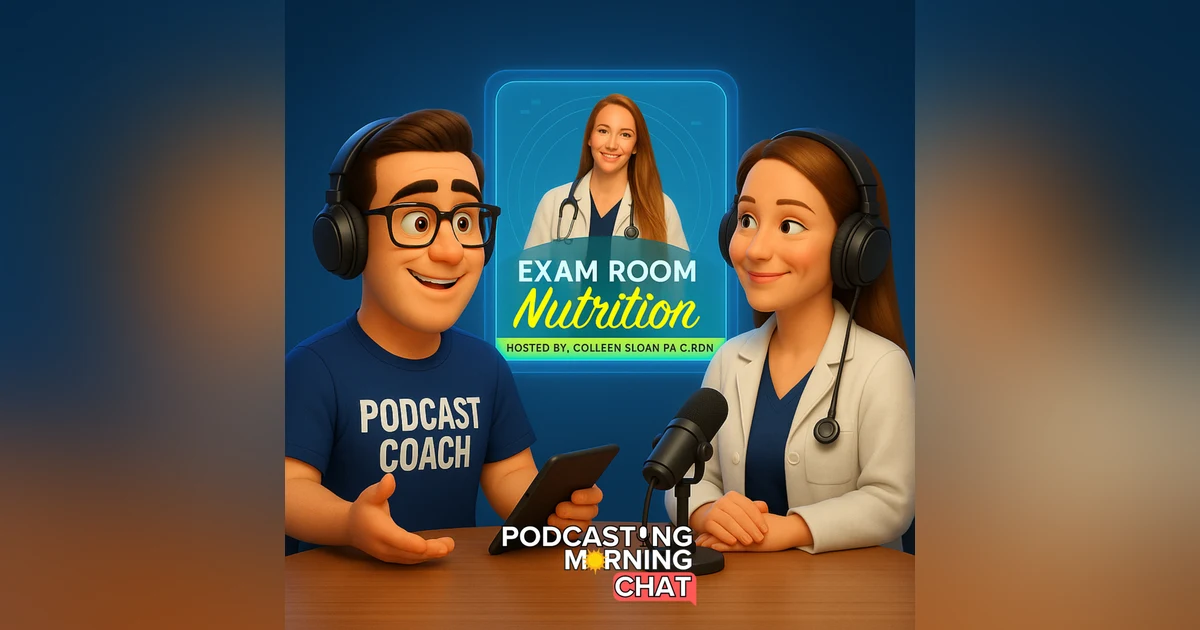


What truly keeps a professional audience listening? Today, we put Exam Room Nutrition under the microscope to find out. We evaluate how storytelling flow, clarity, and pacing shape that crucial first impression, and all of this plays into listener trust. We look at how clearly the episode speaks to its target audience, where the messaging connects, and where it drifts. We also review the title, cover art, and episode description to see if they clearly match the promise of the show. We also break down what keeps a professional crowd engaged and what may cause them to tune out.
Shout out to an OG podcast coach, Cliff Ravenscraft for joining us and being a part of the evaluation team this morning!
Episode Highlights:
[02:10] Podcast Evaluation Overview
[04:36] First Impressions of the Podcast
[06:46] Audio Quality and Technical Feedback
[15:30] Discussion on Podcast Descriptions
[21:44] Cover Art and Title Suggestions
[29:58] Optimizing Episode Titles
[31:54] Podcast Players and Episode Numbers
[32:21] Episode Descriptions and SEO
[52:14] Podcast Outro and Listener Engagement
Links & Resources:
Join The Empowered Podcasting Facebook Group:
www.facebook.com/groups/empoweredpodcasting
Exam Room Nutrition:
To Have Your Podcast Considered For Evaluation, Please Complete This Form:
https://docs.google.com/forms/d/e/1FAIpQLSc8-Xv6O6lrNPcPJwj3N0Z5Osdl-5kHGz_PiAU45U57S-XgoA/viewform
Cliff Ravenscraft:
https://www.cliffravenscraft.com/podcast
Remember to rate, follow, share, and review our podcast. Your support helps us grow and bring valuable content to our community.
Join us LIVE every weekday morning at 7 am ET (US) on Clubhouse: https://www.clubhouse.com/house/empowered-podcasting-e6nlrk0w
Or Join us on Chatter: https://preview.chattersocial.io/group/98a69881-f328-4eae-bf3c-9b0bb741481d
Live on YouTube: https://youtube.com/@marcronick
Brought to you by iRonickMedia.com
Please note that some links may be affiliate links, which support the hosts of the PMC. Thank you!
--- Send in your mailbag question at: https://www.podpage.com/pmc/contact/ or marc@ironickmedia.com
Want to be a guest on The Podcasting Morning Chat? Send me a message on PodMatch, here:
https://www.podmatch.com/hostdetailpreview/1729879899384520035bad21b
0:04 Good morning podcasting, Morning Chat. Today is Thursday, November 13th, 2025. And today it's another podcast evaluation and we're spotlighting exam room nutrition. We'll explore storytelling, flow, clarity, the stuff every creator can use to make their show more engaging. So if you're listening live on Clubhouse, hit the share button, bottom left hand, side of the screen and share it. However Clubhouse lets you. And if you're catching us via podcast chatter, YouTube, Facebook, share this with the fellow podcaster, please. And now give us about 30 seconds. We'll get things rolling. Thanks for being here. Good morning again podcasting.
1:21 Morning, Chad. Thanks so much for being here. I am your host Mark Ronick and on stage with me. Another pretty full house this morning. We have producer Ashley Feller, Sid Meadows, Dr. Faye Feel better, Nick Naul back and also Ralph Steep is joining us as well this morning as a guest moderator. And Cliff Ravenscraft is here as well joining us. And I knew Cliff, one of the Ogs in podcasting. I knew he was going to join us one day this week. And what a great episode to join us this morning. Having a podcast OG podcaster OG in the room. I think this will be a really valuable conversation.
2:03 So welcome to Cliff and Ralph and all the gang as well this morning. Let's dig in. Today we're going to evaluate as we've been doing every Thursday now for the past month. This is our 4th Thursday in a row doing our podcast evaluations. And they're, it's starting to grow in popularity. I think we've now had a total of 10 applications, including the ones that we've already evaluated. But it seems to be picking up and I'm promoting it a little bit more on social media as well. And people seem to be gravitating to the idea. Colleen, the host, Colleen Sloan was one of those people.
2:44 I promoted it on I'm sorry, LinkedIn a couple weeks ago. And she was one of the first to respond. So exam room nutrition. She is a healthcare professional herself. I believe she's APA and a registered nurse. I believe she's also, but I could be wrong about the registered nurse part. But I also know she is a dietitian and this show, her target audience is actually for healthcare professionals, including doctors, physician assistants, nurses, etcetera. And the podcast, she says this is her description, which we'll dig into in a moment. But her description reads where busy clinicians learn actionable nutrition tips, explore ways to provide nutrition counseling despite A hectic schedule with limited time, and learn to answer your patients nutrition questions with confidence and compassion.
3:43 So what I thought we would do first because, you know, we're still kind of getting our feet wet with how we do the format. And I think the the best way to start, just for our audience alone, I think it's going to be important to play at least the very beginning, the intro, if you will. This is again Exam Room Nutrition hosted by Colleen Sloan. You know what a carnivore is, You know what an herbivore or an omnivore is. But would I stump you if I asked what's a nutrivore? I'm Colleen APA, dietitian and your nutrition mentor. Welcome to the Exam Room Nutrition Podcast, your guide to giving better nutrition advice. OK, I just wanted to give you a little taste of the opening so we can all get to know this podcast. Those who maybe haven't listened yet, what were your first impressions when you hit play on this episode? Ralph, you want to go first?
4:41 Go ahead. Good morning. Yes, good morning. Thank you. You know, I, my first impressions were that she's reading a script and I don't want that to, to be a negative effect on the whole thing because I thought the episode was excellent. But my first initial impression, I was out walking the dog this morning listening to this and that was my first thing is she's reading something and I'm disconnecting already. Fair enough. I mean, we know that a lot of podcasters definitely do some scripting, and it's even more common, I think, at those very at the very beginning for those introductions. And I definitely sensed that as well. Ralph, I felt like, yeah, she's reading from a script, but and she hasn't a friendly, warm tone to her voice.
5:26 So I think I was able to get past it easily. In other words, there were inflections. It wasn't a monotone read by any stretch. Sid, did you want to add in something? Go ahead. Good morning. I thought she sounded, I thought she sounded confident. I liked the music. She was very, her voice was very clear. I mean, she sounds like she's been podcasting for a long time, regardless of the fact that she's actually reading an intro script. I thought she sounded very confident and clear and like an experienced podcaster. I would agree with you and I believe this is yeah episode 123. So she certainly has had some experience in podcasting and good on her for moving on and I think she's got now it's even more than that, around 140 episodes.
6:11 So she is all in on her podcast and kudos to her. I agree she did sound professional, confident, which is all important. And again, yes, I'm with Ralph. It did sound feel a little scripted but I thought she did a nice job with the read. What about since she specifically asked for it and I'll share this is the She asked specifically for feedback on her intro and outro clarity and effectiveness. She wants feedback on her overall audio quality, her pacing, engagement, and content delivery. So how do we feel overall about her audio quality? Now, I'm not going to sit and play the whole episode for our audience.
6:52 You can do that on your own time if you'd like. But to our team who has listened through to the episode since she wanted to know, what do we think of her audio quality, Go ahead, DRI. Heard just a little slight reverb going on that when she's talking with her guest it becomes more apparent because her guest does not have any reverb that I heard. So you know, just a simple run through Adobe or a Phonic would fix that. Yeah. And I think that reverb or echo I, it sounded to me like it was the room that she was in. It sounded like her voice was bouncing off the walls a little bit. It it still sounded clear.
7:34 But you know, as podcast producers, we hear those little nuances and we can find some ways to improve it. We'll share that with you if we find those ways. Yeah, thank you, Dr. I'm with you there. I did notice just to be real. And again, this is with my producer hat on. I don't know how much a Gen. a general audience would notice, but throughout the episode, I definitely could hear places where there were some edits, like a little bit too hard of a cut here and there. Didn't sound as smooth as it could in spots. Not all the way through, but in spots. I heard that. Now, Cliff has some feedback for us. Let's go to Cliff. Good morning, Cliff, and welcome.
8:14 Thank you for being here. Good morning Mark and Dr. addressed the actual echo that I heard in the intro so I have not listened to the podcast episode. I didn't know this was the format today, but I think it's awesome. And I want to just say that the very first thing I heard when I heard her voice was the sound of her voice bouncing off the wall in the room. And instantly that stood out to me as oh wow, OK, so is this going to be good? However, that was offset by the very professional sounding, what I would call hook at the beginning of the episode. And I tend to think that a good hook can be very much scripted and communicate, hey, what you're going to get in this episode is this. And I just want to praise the idea that as soon as I hit the play button, I hear what the the topic or what why should I be interested in this particular episode and continue to listen? So I really love that she put that hook right there at the beginning of the episode.
9:21 I don't mind that she read it off of the screen to keep it concise, to the point, get right into it. And I also love the fact that she started the conversation with that hook. If I remember correctly, it was a formed in the question to me, the listener. And I love that all of that took place before she says, this is who I am and this is what my podcast is. And so I, I just wanted to praise that. But I did hear that echo that I heard the room noise as soon as you hit play. Thank you, Cliff. And yeah, I echo what you had to say. It's actually, yeah, I have a note here that I loved the tease at the very beginning, so thank you for bringing that up. I may have just blown right by that in my notes.
10:02 Yeah, that's that was really important to me. It really helped me connect right away. I appreciate that when people start with that hook or that tease rather than just starting with the music, starting with the hi, welcome to blah blah blah. Yeah, I'm with you there. And Cliff, I've been talking about this lately, especially during these evaluation episodes. I want to hear your take because as I was saying to DRA moment ago, we noticed these things like that echo the voice bouncing off the walls. We noticed that as I'll call us professional podcasters, experienced podcasters. Do you think that it may, especially that her particular episode, not just in general when we're talking about room noise and echoing, but her, hers in general, do you think it was that much of A distraction where her audience would be bothered by it, or do you think it's more of a professional thing? My thought on this is I didn't actually think of it from a producer side of it.
11:01 I I thought of it, I'm actually asking myself would I want to listen to this? And what I will tell you is that the quality of the echo and the quality of the sound, it's definitely offset in a very positive way by her professional tone and way of communicating. So her, her communication style immediately helps me take my mind away from the fact that I'm going to listen to her voice with an echo of the room. But I will say that I'm just from a listener of podcasts. I don't like to listen to a podcast where the host of the show has an obvious room echo that could be addressed if they were aware of it. Now, I have absolute grace given to any guest. So if a podcast host is interviewing somebody for an entire hour and the guest speaks 980 or 90% of the episode content and they have a horrible room echo, I I will forgive that because it's a guest.
12:10 And of course a lot of it has to do with the value of the content and the overall everything else. But yeah, the audio quality does kind of bother me when there's a room echo. If I'm want to be taking very seriously and professionally, I'd want to get that out of there. Yeah, thank you, Cliff. And I see Sid wants to chime in as well. Go ahead, Sid. Good morning, Cliff. It's great to see you. Welcome back to the podcast Morning Chat. You guys know I listen to a ton of podcasts and I didn't even notice it. Echo, I didn't notice it. Maybe it has to do with what Phil talked about or excuse me, Cliff talked about as related to how professional and how confident that she sounds. I did not hear the echo and did not distract me. I didn't even notice it was there. And good point.
12:54 And that's kind of what I was getting at, right? Like I do think, and it's just my opinion, but I do think that people like me, Cliff, Dr. Who are producing podcasts or I know Cliff isn't doing that, but Cliff has been so involved in helping podcasters that it's just my opinion that people like us are just more sensitive to it. Whereas Sid who even, yes, he is an experienced podcaster as well, but I would almost classify Sid as a professional podcast listener as well. And if he didn't notice it that it gives me pause. Well, I think it's important to highlight a distinction here. I don't listen to podcasts the way you guys listen to. Your ears are trained to hear things because you're editing shows all day long and you're looking for those little nuances to cut them out.
13:40 I don't listen that way. I listen for the content. I listen to learn. I listen to be entertained and to be engaged, right? And so I'm listening completely different. If I had been trained as an editor or if I did what you guys do every day and listen for all that stuff, then I would likely pick up on all those. Yeah, I agree. Thank you for saying it more clearly than I just did. Appreciate that. All right. Can I add something real? Quick. Oh yeah, Go ahead, Cliff. I, I do want to say that overall I didn't, I haven't listened to the body of the podcast interview. I only listened to the part that you played here in the clubhouse. But I want to say it, it, it didn't distract me at any point. I said the quality of what she was saying, how she was communicating, it completely erased in my mind the focus I had.
14:26 But ironically, it was the very first impression was the echo. It was the very first impression, and it was immediately dropped by the professionalism afterwards. But the one thing that I would say is if I'm 123 episodes into the podcast, if this is something that's a part of all of them, not that it's harming her so far. I don't think it actually is harming her at all, but it can be completely eliminated with some sound absorption. Wherever she's recording, That's it. Yeah, thank you, Cliff. Appreciate the clarification. I hear you. By the way, I'm laughing because I see in the chat here that Ashley is agreeing, right.
15:07 Ashley, I'm just going to go to you. You're you're comparing musicians ears and podcasters ears. Would you mind sharing with with our audience? Oh yeah, I was just making a comparison that, you know, when you're an editor and you produce all these shows, it's very similar to being a seasoned musician where you just over time you pick up on things. Agreed. Let's keep it moving and let's quickly talk about the episode. I'm sorry, the series description and then let's talk a little bit about her episode description as well. So again, the series description where busy clinicians learn actionable nutrition tips, explore ways to provide nutrition counseling despite A hectic schedule with limited time, and learn to answer your patients nutrition questions with confidence and compassion.
15:57 I will give my first overall impression, which is I appreciate that it's short and sweet, understanding right away that this is for busy clinicians that I believe they don't want to sit there and read a long book about the podcast. They want to know, what am I going to listen to? What am I going to get out of it? So I think it for that reason, I appreciate the short and sweet response, the concise, I'm sorry, not response, the concise description. I think it works well. Anyone want to comment on that or shall I continue forward? What? Because there's also the name itself. But yeah, clip. Let's go to you on the description and then let's see what we think about Exam Room Nutrition as a name for a podcast. I think the wording word for word makes a lot of sense as a front value proposition statement that a person can read on a website.
16:53 But in, if you will, it seems a little clinical to speak out loud. I'm going to paraphrase this. I'm so thankful to Ashley who put the transcript of what she actually says, but rather than in the beginning of the episode, this is a podcast where busy clinicians learn actionable nutritional to I'm stumbling over just saying it now. If I were to read it, it's not a big deal. I can actually read it and it's no work problems. So hey, welcome to this podcast. If you're a busy clinician, you're going to learn actionable or I wouldn't even use, you're going to, you're going to learn nutrition tips that you can put into place in your practice today.
17:36 You're going to provide counseling. I would actually try to say that more conversationally in a flow of how you would speak that. And so if anything, I would speak more as a conversational tone, the same message, but not so precise words that I would put in written form as a value proposition on a website. Thank you, Cliff. Some good advice there. Yeah, I see some of the audiences agreeing as well. Yeah, I like to write my descriptions more conversationally. I want people to read it and say, Oh yeah, that's Mark talking to me. I was going to say something a little bit less coming from the other direction. I actually thought the description was perfect if you're a clinician. But then when I listen to the episode, I felt like the episode wasn't really for a clinician.
18:18 It seemed to be like very rudimentary information and I'm not a nutrition expert by any stretch, but I was kind of taken back by that. I thought the content was not really suited towards a clinician, but the description and what I thought I was going to get was. So I was kind of disconnected in that actually. Thank you, Ralph. Yeah, let's put a pin in that. I agree and I think others might agree as well. So once we play a couple more clips, let's get into that. Let's talk about. So let's everybody just start thinking about, you know, the target audience, which again, healthcare professionals just making it simple for you. And does the episode really speak to that target audience?
19:00 So we will we will explore that in a moment. Any thoughts on exam room nutrition? The name of the podcast? Good name. Does it work well? You think it will connect with her target audience? Could it be improved? I don't think the title, the name of the show actually reaches for audience. I understand what it means, but I'm not sure that if you're thinking about searching for things that I'm as a clinician, I'm going to search for exam room nutrition. I might search for nutrition. So I think the name is maybe a little bit confusing. I understand what she's doing and you know any when you're in the exam room with your patient, you can I'm going to empower you with the tools and information you need to talk about nutrition to the patient. I get that, but I just not sure that the name is something that is searchable enough that's going to get her the audience that she's really looking for.
19:53 Fair enough. Yeah, I think maybe you know where this is. Clearly, the objective here is to help healthcare professionals communicate better nutrition to their clients and be able to answer better answer questions more effectively that hurt their clients have so. She could be really simple and say something like the Clinician's Guide to Exam Room Nutrition or the clinician's guide to helping. I don't know. There's something there where she could actually maybe put the title of the audience, the clinician in the name of the audience. She's me in her title. Some way that they it may, it may. I'm stumbling over my words that she may actually attract them that way. I agree, I don't think it necessarily speaks directly to what it is, who it's for.
20:42 Like you get an idea or a sense, but if you just saw the name by itself, would you really grasp what it's about? But I do think in this something I think we should think about and look at for future evaluations. I think the name by itself is really difficult to just look at that whilst we're going to talk like SEO and keywords, that kind of thing. I think we need to pair the title of the podcast with the cover art as well because I feel like that together paints a much better picture. When I see Exam Room Nutrition and then I see the cover for the podcast, that tells me a lot more together than if you just said Exam Room Nutrition. Yeah, and these days the name of your podcast alone doesn't usually stand alone, right?
21:29 It's usually paired with your cover art or it's paired with your social media posts, etcetera. So there is usually a visual that goes along with it that yeah, I agree that can be helpful. And since you brought it up and I don't want to go too far into the cover art, partially because I think her overall podcast series cover art, I think it works well. My one suggestion is nutrition is written in a script font, which will be harder to read in my opinion once you see it on smaller screens. I can make it out, but I might learn more toward a more block style font.
22:10 But I think the coloring's good. I like that it's a photo of her, but I see some other people want to chime in and I'm just curious what people think. She has an actual background of what appears to be her office or an exam room office, something like that. I'm curious, do we like that or do we like something more clean with a just a neutral background or a single color background, something like that. But with that, Dr., did you want to chime in first? Yeah, you just touched on it. What I was going to say in the beginning is that I think if it were me, I would probably lose that background because the background is clashing with the title. I think the title has to be like the star of the show. I would switch up that background. I would do some SEO on that title and also I would add a subtitle like a, you know, an extension even to drive it home more that this is for doctors who don't get that initial education about nutrition.
23:14 So I would do something on that line. Yeah, that could very much help to do that little tagline. Agreed. I'm going to go to Sid and I see lots of people on a chime in here. So I'm going to go to Sid and then we'll see how many more we can get through before we play actually play some clips from the show. I agree with Dr. that I think I said this in my evaluation form too. If she just put a tagline underneath the title, I think it would help to provide some clarity to what the actual show is about. I would like to see her picture be a little bit more zoomed in on her face or upper body, right? Then you can see her better because we all like to know who we're listening to and you know that that image of the person that we're listening to. But I also think, you know, exam room in the title.
23:57 I'd like to see her sitting on a doctor's stool in an exam room. We all know what a doctor still looks like. We all know what a traditional exam room looks like. I'd actually like she looks like she's in the hallway. I'd like to see her actually in the exam room, sitting on a doctor's stool, maybe leaned up against the patient bed kind of thing so that we get that VIB VIB that image clearly. Oh, she's in an exam room. Fair enough. Thank you. Sid. I'm going to keep moving. I'm not going to comment on everybody so that we can keep things moving along. Ashley, did you want to add anything? Yes, I would just say. Reconsider a different color. Other than yellow, especially at the bottom, I think yellow is a little bit harder on the eyes. It's kind of hard to read what's in that yellow box, and that's all I got to say about that.
24:40 OK. Thank you. And Cliff, I'm going to check in with you. Go ahead. I was just going to say that, Sid said. Mine put her on the stool in the exam room with that little table with the sink in the gloves up on the wall behind her and and a little bit more close up. That's exactly what I was going to say. Great job, Sid. Thank you, Cliff. Ralph, I'm going to give you the final word on this. Yeah, I was going to say I would add some kind of nutritional element to her cover art, whether it be a picture of food or something like that, because that's the one piece that I felt like it was a disconnect. The whole thing is about nutrition, but I don't see any of that in the cover art.
25:22 Like the food pyramid or something? Yeah, exactly. Something along those lines just to key me into this is about nutrition. I love the cover art other than that. Fair enough. OK, thank you. And let's quickly talk about the episode title and description. So the title is carnivore omnivore dot dot dot nutravore. How to shift from calorie counting to nutrient density. Here are my thoughts. I'm not crazy about the title, and this actually part of it does go back to something that I think Ralph said earlier. To me, it feels like this is speaking to the patients more than the medical professionals.
26:08 When I look at the title, I think that it's a little busy. It's got a lot, a lot of things to look at and think about. In other words, it's not focusing on just the main concept in like do we need carnivore, omnivore, nutrivor? I know is maybe not such a searched term, but so therefore I think what we need to do is move away from being so specific in this title, but specific enough to where we know what we're going to get when we press play. So here are a few examples. How to fix your nutrition with one simple habit or how to fix your client's nutrition with one simple habit or the diet culture lie that's ruining your patient's health. And lastly, the other idea I had was 5 nutrition mistakes. Keeping your patients undernourished. This speaks more like.
27:01 That one. Oh, you like that last one? Yeah. Yeah, I do. And look, I admit that sometimes we here at the podcasting morning chat when we talk about multiple topics and sometimes in depth, Ashley and I have a hard time sometimes with the title. But what I've been working on, or we've been working on, is kind of being OK with picking one thing and sticking to that instead of trying to load the title with as much as possible. I think the clear and concise route works better, and we're testing that right now. You're spot on with the things that the rewording of the title. I think those were great. The only comment I would have about the title is she needs to lose the number. She doesn't need to put the number in her title. And that's another one that we at the podcasting morning chat originally we're not doing.
27:51 Then we decided, I decided to add the episode number back in because I do that thinking about our audience and being able to reference episodes and and find them quickly. Yes, I know that you can find the episode numbers displayed on most podcast platforms, but they're not always in an easy to find, easy to see place. And so putting it in the title is why that's why I put it in the title. But I recognize that it's it's not helping me for search engine optimization or just general searches. I don't think it it's working as well. I'd rather just start with the value and not messy it up with the episode number. I'm with you there.
28:34 I just want to say I've got over 5800 podcast episodes in. Every episode starts with a three digit number. If I launch a brand new podcast, it's 001. And I definitely do it for the purpose of the fact that hey, once I have sixty 7080100200 episodes in, I don't want you to, I want to be able to say go back and listen to episode #749 of this show. And I might actually be saying this in episode 948. I don't want them. I don't want to rely on what podcast player they're looking at. They could go to my website and type in the at the number I said in the search bar.
29:15 They'll take it right to it. I'm a huge advocate for putting the three digit episode number at the very beginning, even when Apple used to reject new podcasts for doing it. Thank you, Cliff, and I appreciate you standing your ground on that one And it, you know, of course, now you're making me rethink my strategy is again, because yeah, I'm with you there. I want it to be convenient or a convenient experience for my audience. I get it. I agree 100% with what clip just said. I think the number provides an easier way to direct people to other episodes. I always have the number in my episode titles and I would continue to do that. I like the episode numbers.
29:56 Yep. For the titles as a whole, though, I would say excite. After seen that one, I went back and I started looking at some of the other episode titles and I feel like a lot of them are very long. They almost every single one of them got cut off on the podcast player and it seemed like the most important stuff, but the keywords, the things that were really going to hook me were on the part that got cut off. So I would suggest like flipping around some of those titles that she's got for the episodes and make sure that you're putting like the real value right at the beginning of the title so that everything else gets cut off. Isn't the important stuff. Yeah, I did actually notice that too. And I had run it through a character counter and I think this episode was right around 90 characters, which is feels a little too long for me to.
30:44 And yeah, I think that any one of the episode titles that I threw out there, I think that will solve that length issue, if you will. OK, we still haven't played clips. And I want to quickly ask everybody to 1st, if you're listening live right now, answer the poll that Ashley just put on the top here. Vote for whether or not you prefer episode numbers in the title. Just curious and we'll share those results with you. To that point, the episode numbers like if a host as a listener, if a host says, hey, go check out this episode and gives me the name of the podcast episode and I have to scroll through like cliffs that he's got thousands of episodes and I got to scroll through to find the exact title of that episode. I am going to lose my mind if he says go to episode 23 and I have to scroll to the bottom of 2000 episodes, but I know where I'm going.
31:38 I so much more appreciate that, more likely to click on that versus go hunting for an episode that I don't know where it plans. I think that this speaks to the biggest need of all, at least along the lines of this topic. I think these podcast players need to just figure out a way to display the episode numbers in a prominent place so that we don't have to do that. Because it is true that adding the number at the front could hurt as far as search purposes go, right? But I just wish the players would find a way to do that, display that episode number. Matt, welcome to the stage. What did you want to add?
32:19 And then we got to move on to the episode description. Hello. This is why Podcast Addict has the staying power and I think is one of the best podcast listening apps out there because it doesn't have that problem with episode numbers. They are very easy to see whether they're included in the title or not, and it has so much flexibility. I think it's just been around long enough that it's not an issue, for whatever that's worth to anybody. I don't know about the pocket casts of things, but. I've forgotten about Podcast Addict. It's been a while since I've used it. I'm going to pull that up and start playing around with it just to experience that. Yeah, thank you, Matt. Great suggestion.
33:00 Appreciate it. And Dr. did you want to add something, by the way, before you do, just want to share the poll results, around 10 people so far. It's 5050, there are more of you listening than 10 people or so that voted, so please vote. Do you put episode numbers in your title? And if you're maybe starting a podcast and haven't yet, what would be your preference? Or if you're a listener, what's your preference? Do you like seeing the episode numbers in the title? Go ahead, Dr. So I am team number for a long time and it's funny, I just listened to Courtney Elmer's episode on this yesterday and she is not team number and she gave her reasons.
33:45 That's fine. But I'm still this is a hill that I'm willing to die on. Even if let's say you reference a past podcast in an episode that you're talking on. I mean, you can definitely link it in the notes. That's fine. But what if you're on the, you know, the speaking tour and you're talking to large audiences instead of saying, well, I did a podcast. It's called Monetization in the New World. No, just give the number if you're on that speaking tour. It's just so much easier. Thank you, Dr. And while I have you, I know you had some no, you had some things to share about the episode description itself. And I'm not going to read the entire well, I guess I can read most of it.
34:33 But it basically says today's episode will change how you think and talk about food. Instead of obsessing over calories and cutting carbs, what if we taught patients to focus on nutrient density? And then she goes on to say, I'm joined by Doctor Sarah Ballantyne, best selling author of Nutrivor. You'll learn how to shift the conversation from restriction to addition and give patients permission to enjoy their food and improve their health. And then she shares a few bullet points of what you'll learn. She provides the links and resources, how to connect with her and a disclaimer at the end. So, Dr. You had some thoughts on this? I kind of did a a revised edition of the podcast description and it was.
35:19 As a clinician, your patients look to you for clear answers. What should I eat for diabetes? How do I lose weight My child refuses to for to eat vegetables. What now? At most medical I'm sorry. Yet most medical professionals receive minimal nutrition training. The National Academy of Science recommends 25 hours of nutritional education, but many clinicians get fewer than five. I went on and and I know the value of a short description, but we're also dealing with SEOI want to grab all that SEO goodness that I can. And honestly, I think probably doctors are going to read half of what's there. So that makes it even.
36:04 You should be even more mindful about putting the meat in that upper half above the fold, as they say. Thank you, Dr. The one suggestion I would make if you're going to go a little bit longer or if you are worried about making sure to capture the keywords that you want to capture, I would say for this particular audience, doing it mostly in bullet points might be helpful because again, when we're talking about them being on the go, wanting stuff quick. Right, format it differently. Format it differently so that it's easy and quick to read. I have a question. This is probably going to be another 5050 debate here, but in those show notes, the description, there's a character limit I believe. And should you put chap markers and time stamps there? She does not include it to the point of DRI. Listen to the same episode from Courtney yesterday. She has the time stamps there and when you click on it, it goes straight to that portion of the episodes. Is it?
37:03 Do you include the chapter marker slash timestamps in that notes section or do you not? This is a tough one because more and more of the players are now automatically adding those. Spotify, Apple, they're automatically adding chapters now. So theoretically you wouldn't have to, but if you want to play to all the players that may not do that, then I think they're it's an advantage to include chapter markers, especially if they're clip clickable and you can jump around. And again, especially for this audience who may want to just jump to different areas to quickly get some information. So we played the main intro.
37:44 Let's play the setup for the intro and hear what you guys think. Nutrivor, A noun. A person who chooses foods to supply all the nutrients their body needs to thrive. A way of eating built around nutrient dense Whole Foods, not restriction. Now, when I first heard about the book Nutrivor, I immediately knew I wanted to speak to the author because so much of what I try to teach patients aligns with the core message of this book. Nutrivor isn't a diet book. It's a completely new way to think about food. Instead of labeling food as good or bad, Nutrivor teaches us to zoom out and look at the overall quality of the diet, choosing foods that over the course of the day, provides the essential vitamins and minerals our bodies need to thrive.
38:36 So today I'm thrilled to be joined by Doctor Sarah Ballantine, the New York Times best selling author and the creator of Nutrivor. In this episode, you'll learn how to explain nutrient density to a patient in 60 seconds using a car analogy that your patients will love. You'll learn what to say when a patient tells you that they don't like any vegetables, or says that healthy eating is too expensive and why the old Eat less, move more approach to weight loss is really outdated and potentially harmful. This episode is a powerful reminder that small, doable changes, like adding just one serving of vegetables a day, can move the needle on your patient's health in really big ways. So that is the episode introduction. What stood out about the way Colleen set up the topic and introduced her guest Who would like to share? I thought it was too long, but I love that she told me what I was going to learn.
39:33 That she's reading, obviously, which is fine, but I love that she told me, hey, this is what you can learn in this episode and this is what we're going to do and this is who we were talking to. But I felt like it was too long. I agree, even for me as the listener who may not be as rushed as maybe her audience is. So yeah, I'm with you there. Sid and Matt, did you want to chime in as well? I listened to it initially and I didn't have a problem with it because the vibe I get from her podcast and again as as Diaz pointed out, I've missed half this conversation so do stop me at any point if I go over anything you've talked about. But the vibe I get is that she is an educational podcaster. She is telling you about material and when I heard her go in depth about where the conversation was going to go, it does two things for me. The 1st is it outlines the learning objectives of the conversation in a really detailed way. Which I think is important.
40:25 It doesn't matter how long you're on the train before someone needs to take the turn off. Sorry, I'm mixing my metaphors here, But the density and the length that it took to get to that intro, objectively, it's long, but it gives you what you need to decide if you want to listen to the episode. And I think it gives you enough to realize that even if you don't know enough about the material, you've got enough there to get in there. Now, the second thing that it does is that it kind of pushes beyond a level, a point at which retention is counted and would be calculated as being effective. And it also gives you a time stamp fee to know when people are jumping off the intro, presuming that they've either A heard the material before and don't want to listen to it, or B, they just weren't interested in the episode.
41:11 So I think that length isn't a problem for me. I think it does its job well. And being an educational podcast from a Doctor Who's also sharing material from other people and potentially herself, but also claiming that this information is, you know, not medical advice and da, da, da. That disclaimer was in her show notes as well. I think it does a good job, but that's just my opinion. Yeah, and that's why we do the podcasting morning chat is to get a variety of opinions and not just Force One opinion down our listeners throat. I hear what you're saying and I clocked it. The official interview itself actually begins around 2 minutes, 45 seconds into the show, which in my opinion, I mean, I put out a piece on social media that's to this day on TikTok and Instagram, still one of my more popular short form videos and it talks about getting to the point within the first 3 minutes of a podcast episode. And I still stand by that.
42:09 I think if you can get it out there and of course you're delivering value and entertainment, I think she did a fine job of meeting that requirement of under 3 minutes. I want to play one more part here which will fill that two-minute, 45 seconds that I just mentioned. I appreciate here she does a little what I call here on the show, a little housekeeping. After we hear what we just heard, I want to play it for you and then I want to let's talk about. It Now before we dive in, I wanted to let you know that I'll be taking a short break from the podcast as I help my daughter get ready and settled into the new school year and work on a few projects that have upcoming deadlines. But don't worry, I'll be back with new episodes on September 3rd.
42:57 Now in the meantime, please let's stay connected on Instagram or LinkedIn. You can find me at Exam Room nutrition, give me a follow and send me a message letting me know that you are a podcast listener. And don't forget to browse the podcast archives. Over the past two years, I've covered a ton of nutrition topics that I'm sure you'll find super helpful and inspiring. All right now get comfy or drive safe and enjoy my conversation with Doctor Sarah. And I like the little whoosh there at the end. I think actually she could have made that a little louder for a little more impact. But I do like the the segment break there. And I like that she's called this out and that she's talking to her audience and she's telling them I'm taking a short break. And I especially appreciate that she's actually giving them things different ways to connect with her during her absence. My one piece of constructive criticism. I wish this part wasn't scripted. I'm OK with the scripting, much like Cliff said. I'm OK with the fact that she was reading from a script up and up until this point.
44:07 Because to me, I want it. I want to feel like she is leaning in and talking to me, you know, one-on-one. I don't want it to feel generic. Let I want to feel this part and I think that can go a long way. I appreciated the, you know, this is where I'm going to be and, and it brought everyone into her world about I'm going to put my daughter through school and blah, blah, blah. I did feel like it was a little too long, especially when she went in to take a look at the archives. I think that that probably could have been cut off. And there are some people, yeah, there's some people that are saying it should have been at the end. But, you know, I thought about that. But just like people who are used to fast forwarding through those commercials on other shows, people are also likely to, you know, cut off and go to their next their next show that they have lined up without listening to the end. So she's damned if she does, and she's damned if she doesn't on either end.
45:09 To me, it's going to stop me like in my tracks if, when, if the host again, I don't care where she's placed it. Like I think it's a good place for it in the beginning to be honest, but. Right, if they haven't fast forwarded already. If I'm a listener and I hear I'm going to be pausing the podcast, I'm going to be taking a short break. Well, now I'm leaning in as a listener, like, why? What's going on that might capture my attention, which is a good thing. Thank you, Dr. Appreciate that. Go ahead, Janae. Good morning. So the intro for me felt just right, mainly because I'm interested in this topic right now, right in my life. I'm interested in topic looking at what I'm eating. So it's like, OK, this is really interesting because I really like where she's taking this because as somebody who's watching my diet, eating what I'm eating, the supplements, so this is like, OK, this is really interesting because I want to listen to this.
46:03 But then at some point I was like, OK, I'm not down. Like, again, it all comes down to the thought process of what you're going through As somebody who wants to listen to this topic, there's some controversial things in there. So that might make me interested to come in and listen to more. Makes sense. Thank you, Janae. Appreciate that. I'm going to play another clip and one of the things I want to make sure we address here is something again that Ralph had brought up earlier. And I think some others had felt similarly about the fact that is this episode really speaking to the target audience. So let me play this. But I did appreciate this exchange. But yeah, I want to keep that thought in mind as we listen. So my first question is how do we explain that concept of nutrient density to our patients and why should they care about that?
46:53 I think it's a really challenging concept to communicate in a very short period of time because it really goes against the grain of how like all of the messages that were inundated with all the time from diet culture, which is almost like that that if you think of like the tug and and pull between teaching patients about nutrition from an evidence based perspective versus all of the things that they're reading online. So I think the most important message to give in a short period of time is nutrients are raw materials. Your body needs nutrients the way a car needs gas, but also oil and brake fluid and wind shear wiper fluid. And so we've, we've got this like big collection of things that our bodies need to do, all the things that our bodies do in a healthy way.
47:46 And that's what vitamins are, that's what minerals are. And so we'd want to look at when we're choosing foods, not just look at the energy, not just look at the gas that that food gives us, but does it have the brake fluid? Does it have oil? Does it have a winter wiper fluid? All of the other things that the engine needs to run smoothly. So this clip I loved. I appreciated the analogy. And at first when I heard it, I was thinking, if I was a healthcare professional, would I be jiving with this? Would it maybe feel like they're almost talking down to me? Because I probably, I feel like I probably should know this. But at the same time, where I convinced myself that this is not a problem is because what this is doing is it's, it's giving fuel, pardon the pun, it's giving fuel to these professionals, It's sharing a way to communicate effectively in a relatable way with your patients. So although that this information initially in this part of the interview, the beginning, although that part is maybe fundamental, maybe obvious, but the actual messaging may not be so obvious for a professional. So this might help them communicate better with their patients.
49:05 To your point, she's teaching the medical professional how to quote UN quote, speak English to the patient. We've all been there where we've been into an exam room and the doctor, PA is talking so far overhead, we have no idea what they're saying. And I've even said to a couple of them. And could you write that down? My wife's a nurse and she can explain this to me better, right? So we've all been there. So I love that she's giving you a tool that you can use to explain something really important to someone who they're going to really understand it in very simple terms. I agree with that at the beginning, but the problem is then she loses that in the rest of the episode because she made a statement at one point. And I'm fixed on nutrition as well. Just drop like 70 lbs.
49:51 And so like, I'm in tune with this, which which is great, but that's not her target audience, though. And she makes statements later on about how vegetables that you get in the can and in the frozen Ohio. That's great for an individual to hear that. But a practitioner, in my view, is going to zone out and go, no, you don't know what you're talking about. And I just feel like she's disconnected with her core audience of who she's trying to reach. Not in that quote that you did, not in the clip you just played, but later on in the depth of the episode. And when you say she, are you referring to the guest or the host? Well, I think to get, I think the host needs to direct the episode. I mean, that's the host job is to direct it. I'm bringing a guest on to suit my audience regardless of what the guest wants to mention. The host job is to make sure it's relevant to my core listeners.
50:41 So I feel like that's the disconnect. Again, this might speak to in parts, maybe not the whole episode, but this might speak to, again, what we were saying. What I was saying and Sid was saying is that there's this fine line here of both communicating with the target audience who are medical professionals, but also teaching them how to communicate with their patients. So there's going to be this a little bit of a muddied area here where sometimes it might feel like the audience, the target audience is being taught about medical stuff, but it's maybe more about how they're supposed to teach it to their patients. Yeah, I want to agree to a degree with Ralph.
51:21 I think I wrote this in my evaluation form. My biggest concern, if I had to say concern about this episode specifically, was there were points of the conversation. I was confused as who was the target audience? Is it the clinician or is it the patient? And I know she's trying to talk to the clinician, but I do think there's some confusion here of actually who she's talking to and if she can clear that up. Because a couple of places they refer to me like a patient, like they're talking to me. Other places they're talking to the clinician. So a little bit more clarity around that I think will help the reach of the shift. Thank you both Ralph and Sid. I want to do this before we wrap up because again, she asked, Colleen asked for feedback on intros and outros and we haven't gotten to the closing yet. So let me play that for you and then let's get some feedback. Thank you so very much for the gift of your time. I know you're so, so busy, so I really appreciate you being on the show today.
52:18 Thank you again for having me. Well, I hope this episode gave you a new lens to view nutrition through, one that's focused on adding value, not restriction. Now, if you're wanting more ways to help patients in their health journey, I would love to invite you to join the Obesity Medicine Nutrition course. It's an on demand CE accredited course that gives you 10 1/2 credits, lifetime access to a growing community of like minded providers, and tons of bonus resources. One of the members, Jayza, said it's one of the best investments I've made. I'm a new dietitian and new to private practice, so I was apprehensive about spending the money, but I think it's worth its weight in gold.
53:01 Thank you, Jason. So head over to examroomnutrition.com/course and use code POD 15 to save 15% off the entire course. This is my way of thanking you for being a loyal podcast listener. Now, if you've learned something that you can use in clinic this week, do me a quick favor, leave me a short review in your podcast app. This helps other clinicians like you find my show. Well, thanks for carving out time for nutrition today. As always, let's continue to make our patients healthier, one exam room at a time. I'll see you next month. Let me weigh in first. I want to say that one, I don't know if it's criticism or not. One observation is I thought that interview wrap up at the end there was a little too quick.
53:45 I would have liked a short and sweet wrap up from Colleen at the end after she says her goodbye to the guest, maybe with just a couple of quick takeaways. Again, I wanted to be short and sweet because I'm keeping the audience in mind. Dr. Did you want to comment at all about the call to action at the end? I probably would have put that as a mid roll because like we said before, people are apartment to Fast forward to the meet or you know cut off altogether after the interview's over. So I probably would have put that in the mid roll and then it would have left time for, you know, a couple like 3 bullet points for takeaways.
54:26 Yes, and I also thought it was maybe a little too a little too loaded at the end there. Too many things to do. Too many things, yeah. So another, that's another vote for putting the course information mid roll so that at the end, yeah, you can actually give your takeaways and encourage people to follow the podcast, leave a review, whatever action you'd like them to take. I'm with you there. Yeah, also I want to talk about that little whoosh. I was, I am like a music outro person. I want to hear music build that. I want to hear it fade that I want to hear you talk. The whoosh was appreciated, but I think it should have been bigger. It should have been had more of a statement, you know, to make the transition.
55:10 I'll say this, I am that way too. DRI like having the music lead us in and out as a transition. And I, I sometimes wonder how effective that is in a digital format because to me what we're doing is we're cueing our audience that OK, something is ending here. And if they see at that we are literally about a minute or two left into the show, they may say, oh, it's ending. OK, I'm good and they may check out. Whereas this, it kind of sneaks up on you. You just get that whoosh, like, oh, it's over, and then she's on to something else. Maybe, but hopefully it's being edited to where the guest is saying something, you know, interesting enough to listen through and then and the, the music bed is there and then it swells up and then you come in with those, those 3 takeaways. And plus it's a matter of training your audience as well. Oh, there's going to be takeaways. Right.
56:11 So I want to listen. You know some. Yeah, great, great points. Dr. Anyone else want to share anything else overall or about specifically the the closing? The episode itself about exam room nutrition? Any final thoughts? Anyone take away? If you had to give her one take away today, maybe you've already shared it but you feel it's important, what would that be? We all fall into this trap of. Do this. Do this do. This and the listeners going well, what do you want me to do? Go on your e-mail list, Follow you on Instagram? Like we all fall into the trap of giving them too many things to do. Just be super clear and IA 100% agree with Dr. and I put this in my evaluation as well. She needs to sponsor her own show. Katie Brinkley has started doing this where she swooshes into an ad midway of her show saying today's episode is brought to you by my business next step social and she does a little 32nd ad.
57:07 That's exactly what Colleen can do about her program because I know that her goal is to get more people into her program. Sponsor your own show, put the ad mid roll and give them that call to action there to come join in. Love it. Great advice, Sid. Thank you. And if anyone else doesn't have any final words layout, let me go to Matt and then we're going to take us home. Go ahead, Matt. Just very quickly on Sid's point there, the when I had a quick look at it after someone made a point earlier, I was trying to find what the through line is without listening to the show at all to see what the stuff around it was and it wasn't too clear. There's a like a Co file or something, but everything else isn't super clear. So I think just having a bit of a rethink around how it sits in with everything else that she does because she does other stuff clearly and maybe how this content canmore closely align to that.
57:59 And then, you know, Sid's suggestion is that we'll have some clear actions to include as part of that self sponsorship. Thank you, Matt. And I will say one thing we haven't mentioned today is overall I thought that she did a a nice job interviewing and she certainly felt prepared. Her questions were on point with the conversation and there wasn't a, a big rapport between her and her guest. I would have liked to feel like they knew each other a little more. There was just, I don't know, there's just a little more chemistry. But overall, I thought the interview, I think she did a, a good job and she was well prepared.
58:42 So Colleen, if you're listening, oh, who who wanted to chime in and then I'll. That was me. That was me. Sorry. I just want to say one more thing about this. 26 minutes, actually. 23 minutes. What's her interview? It was packed with value and actionable takeaways in 23 minutes. That's really, really good for an interview based pockets. I struggled to keep mine at 30 minutes and most of mine are in the 40s. So the fact that she got so much value extracted and taught you in 23 minutes, I think you're 22 minutes, whatever it is, is actually really good and she should be commended for that as an interviewer. Thank you, Sid. Appreciate that. I just want to say that I found the metaphor that her guest shared for the different ways of thinking about the micro and macro nutrients was brilliant.
59:32 And it was a reminder to me to keep the clinical language out and speaking stories that people can understand. And even though I'm not a clinician and I'm not her target audience, I pulled away an insight and I just wanted to say that that was incredible. Thank you, Cliff, Great point and thank you for your feedback today and thanks to the whole team for your feedback today. I think that this was helpful for Colleen. Colleen would love to hear from you and let us know if this helped you in your journey. Good job. Keep going and we'll be following along. On your journey. So if you want your journey shared on this show and you would like your podcast to be evaluated, check the show notes.
1:00:16 We will put a link there to fill out a quick and easy application to be a part of our evaluation series that we're doing every Thursday here on the Podcasting Morning Chat. And of course, for all things Podcasting Morning Chat, whether you want to find out where to watch, where to listen, or go back to some past episodes, just go to podpage.com/PMC or for the first time, podcasting morning chat.com. Until tomorrow. Make it a great day everybody, take care.


